Featured

The Devaluation of Doctors

I was reading our kids Snow White and the Seven Dwarfs yesterday. A classic that as an adult you realise is creepy-as. We get to the bit where Snow White (bless her cotton socks for tucking into the obvs poisoned apple) is laying there in her glass coffin and prince Charmsville comes along, instantly falling in love with a corpse. If you’re able to move past the necrophilia, here comes the real shocker. The story reads that it is when they are carrying her back to his pad (?!) when someone trips and the coffin accidentally gets tossed about, thereby dislodging the piece of stuck apple in her throat that’s been causing all the problems. There is no corpse kissing in the original Brothers Grimm version of the tale – that was Disney trying to sex it up. And like a fool I never questioned the saviour prince kiss. A kiss that is replicated across the Disney franchise and tells impressionable little girls they need a knight in shining armour. For anyone who’s interested, the original story also has wicked stepmother dancing in shoes of hot coals until she dies at the joyous wedding event of Snowy and Charmsville. You’ll be pleased to know they missed out that delightful detail in the version we have. Not that she didn’t deserve some comeuppance, but I’d rather my 4-year-old didn’t feel mummy endorses torturing until death as a legit punishment option even for her cruel misdemeanours. Overall feeling on the original story? Gives with one hand, takes with the other. 

This all got me thinking about how easily we can get sucked in to believing nonsense by people clever enough to sell it to us in the right way. It’s how advertising gets us all. On a darker and sombre note, it’s how some of the worst atrocities in our history have been supported by thousands – if not millions – of people. Right now, there are many, many Russians who believe that bombing the Ukraine is justified because Putin and his cronies’ have careful state-controlled propaganda telling them so. 

I want to discuss with you how I believe Tory-driven propaganda, supported by the media (such as our NHS friend the Daily Mail, or what I shall henceforth refer to as DF, Daily Fail), continues to churn out misinformation about Doctors and our NHS. This torrent of negative tripe leaves the public confused, and the medical profession feeling demoralised and devalued. I am a GP so it is maybe easier for me to see the impact on my profession, but equally I do not think it’s far-fetched to say the abuse is commonly directed towards GPs in particular. It’s more common to find a money-grabbing GP headline than that scoundrel oncologist, you know? 

Karen (sorry to anyone lovely called Karen or any other name referred to in this blog in a less than shining light, I’m just picking names for story-telling purposes)

Last summer I saw Karen in clinic for an ongoing cough. Nothing unusual there, until we get to the end of the consult, and she pipes up with ‘so when are you going to start seeing patients in surgery again?’ I look up in bewilderment at the patient sat in front of me clutching the prescription evidence of being with me in this very room with her. I give Karen the benefit of the doubt and take a scroll though her records over the past year, checking to see if she’d come in since we’d open up our doors to any appointment type – could there have been a chance she’d missed the free-for-all booking memo? No. Karen had been in to see a healthcare professional in person on an almost monthly basis for various ailments over the last year. So, I say to Karen in the most kind and un-enraged tone I can muster ‘patients have been able to book in person reviews for over a year now, and I see you’ve been in a few times. Can I ask why you think you feel you can’t see us at the surgery here?’ 

Karen goes on to explain that ‘it’s what you read about in the news’, referring to the most recent unhelpful headline churned out by the DF. We conclude the consultation, and I somehow manage a forced smile to the departing comment of ‘don’t work too hard!’ Well Karen, I have another 20 patient contacts on my list for the morning on top of the 30 I’ve already dealt with, so it’s unlikely that I’ll get the chance to piss anytime soon, but thanks for the well-wishing, I will bid you adieu until the next time we no doubt see you in this building, you know, face to face. Please save some of your unhelpful banter for that trip. 

Karen obviously had no idea how terribly demoralising that consultation was, and I’m sure she would probably be sad to know how incredibly frustrating her comments were. As crazy as they sound from someone sat directly in front of me, I feel like her slightly misplaced beliefs are quite commonplace. Let’s consider some other common DF-type gems that crop up, shall we?

GPs are lazy, and they work part time.’ 

Ok, let’s consider the above Karen scenario. The British Medical Association (BMA) recommends that the maximum number of patient contacts for a GP a day should be 26. The number of direct contacts I had in just that morning was at least 50. That means that in a regular day in General Practice now on average we are probably dealing with 3-4 times the BMA safe workload advises. That is before you add in every indirect patient contact, every result and prescription request you have come through. It is relentless. There are no easy or even easier days in General Practice anymore. Every time I walk through the front door of work, I know there’s a chance at some point I will be so exhausted that I may well make a mistake. After a 11-hour day (a day where I’m supposed to work 8 hours), I then have to wade through the paperwork generated. So, when Rishi says I’m having a ‘morning off’ what I’m actually doing is sorting out all the work I should have had time to do the previous day. Because I want to be able to write a decent referral onto the orthopaedic team, and not just trot out a ‘Hi, please see this leg, many thanks.’ I also really need to start chipping away at some of those targets we have as GPs, ensure all the coding is in correct order, or we quite literally do not get paid (if you believe GPs mostly get paid for seeing you with a cough and cold, you’d be sadly mistaken). Oh, and yes, it would also be nice to see my children from time to time. Does that make me lazy? Maybe it does, but if that’s the case I sure as hell don’t want to know what it is to work hard. 

To get to this point in my career, I have had to excel at school, get into medical school, fund a 5-year degree that left me with consequent debt extraordinaire, and survive through the sheer hell of junior doctor years. On my first day as a junior doctor covering surgery, I worked a 13-hour day where I didn’t eat, sit down or go to the toilet. I had a drink because some kind nurses thought they should probably look after another rough-looking junior doctor. That night I slept badly, partly worrying if some of the life-changing decisions I made were right, partly from leg and feet cramps from presumably not having had anything but water all day. The next day I get up and do it all over again. 

And what was I paid for that first junior doctor job? A little over £21,000 (2011). Currently junior doctors are being paid an average of £14 an hour. We’ve all read stories similar to mine above, but there are those that still chose to believe Tory and DF bashing that those doctors, and in particular GPs, are all lazy and entitled and don’t deserve to be paid any more money. For anyone who went into GP as a partner 20-30 years ago, life was a lot peachier. But the reality now is many practices are going under and handing back their contracts because they simply cannot stay afloat.  Not long ago I read a DF article about how GPs were all money-grabbing because we were paid to deliver the vaccines. So, it’s now not even good enough that at the time GPs were instrumental in delivering one of the only UK COVID success stories, putting ourselves at personal risk and giving up days of our life to deliver a service that created enormous additional workload. The DF believes we should have done it all for free? But I’m sure they also said we need to have a clap for our efforts, so that’s all ok then – we won’t be able to afford tea, but we will get by with that warm fuzzy feeling of a group clap. 

‘Doctors are arrogant’

I think this feeling needs to be aired as a slightly separate issue. There are some that treat me differently after finding out I’m a doctor. Not that I announce the fact freely – we all know some who take the news as a free ticket to use you as their personal physician. What I’m talking about is the almost extension of the inferior-complex date syndrome – where boys/men feel their self-esteem ebb away on finding out you’re a medic (disclosure that I’ve not experienced this, but I hear it’s a thing). It’s like as a doctor some believe you must know everything and be able to interpret the innermost secrets of your liver from just looking at you and are therefore some kind of intellectual threat. I mean huge spoiler, we don’t know everything, and I need an extensive history, examination and probably bloods and ultrasound before I can tell you much about your liver. 

I have no doubt other professions feel this too, but the problem is with being a public funded service is that those complex feelings of self-driven insecurity are exploited by the powers that be. It makes doctors, especially GPs, easy targets to portray as the arrogant band of millionaires that need taking down a peg or two. I absolutely believe that my job is important, that I deserve to be treated with respect, and that my work should be appropriately valued. But that is true of anyone who puts in a hard day’s work (including historically undervalued and unpaid childcare, but that is a story for a different day). If I ever gave the impression that I believe I was better than anyone I would be mortified, and I know the vast majority of doctors feel the same (save one neurosurgeon I once had the pleasure of assisting in theatre, he was the very advert for arrogance, but he was also short so there was also some short man syndrome going on there). The truth is we live in an economy that judges our work value by way of renumeration. We need to ask ourselves if it is arrogant of junior doctors to want to be paid more than £14 for what they do. Honestly, I think it’s crazy that is even debated. 

Sickly immigrants cause NHS bills’

This enrages me. The belief that immigration is to blame for the demand placed on the NHS. If it wasn’t for all these people the NHS would be fine, right? Brexit has given racism a very sad green light. It’s that feeling that as a group we voted for the belief that letting all these pesky immigrants into our pure England and dishing out lots of cash to a bunch of foreigners at the EU (for all those much needed and collectively beneficial causes) were key reasons why our NHS was going down the plug hole. Good on us, we’ve got back our sovereignty, saved our economy and the NHS and put two fingers up to the big man. 

How’s that all going now then? Oh yes, there is if anything less money for the NHS because that Brexit bus promise was a lie. And we are desperately needing qualified healthcare professionals to come work in the UK from abroad – something that many of them, very understandably, stopped doing when the over 65 population decided to screw us all over with votes to leave one of the best things that’s ever happened to the UK. So now we are having to fork out more money to entice qualified professionals over. And partly because we no longer have access to the markets in the same way, we have to pay through the tooth for medicines, and end up with a lot of shortages. There are many studies that show the burden on the NHS from immigrants is no greater than those UK-born, and indeed some clearly show usage is less amongst our immigrant population. Overall EU immigrants have a net positive economic contribution to the UK economy. But Boris and his club of COVID jingle minglers, together with the DF, told us that Brexit would be better for the NHS. And it still makes me quite genuinely sad that too many believed them. 

There are three main reasons why the NHS is struggling with demand: an ageing population, the rise of long-term health conditions and ever-increasing expectations. Unfortunately blaming the EU and throwing shade on doctors is a lot easier than actually dealing with these problems. It’s much easier than dealing with the catastrophe of social care and our broken society. It’s much easier and sexier than funding delivery of proper preventative medicine in primary care – something that would truly bring down the rates of life-limiting, money-draining long term health conditions like Diabetes, heart problems and strokes. And I believe it’s right that everyone should have an expectation to receive good quality health care, but throwing blame at doctors is easier and wins more votes than dealing with the epidemic of Karens demanding that they be seen for their fungal nail infection within the next 2 weeks. Expecting good quality healthcare is one thing, being an entitled Karen threatening to complain if she doesn’t get her nail lacquer is another. 

Before the inception of the NHS many people with any serious health condition had to choose between death or poverty. Analysts think that there was some kind of nostalgia element to the Brexit vote – a yearning for a ‘better time’ before joining the EU. I totally get that many of us hold a candle for our formative years, but the thing is, Mavis, times were not better. Back in the day treatments were very limited, and really nasty stuff like Polio signed a death warrant for many.  And yes, for the good of the planet we need to think long and hard right now about how many more people we want to add to it as a whole. But did you know every single person living in England is descended from immigrants? The first to call themselves English were likely descended from Northern Europeans. So, what are we saying, we only don’t like the types of immigrants who look and sound a bit different? Oh no, because we are also ok with the doctors and nurses who may look and sound different, we need them. I mean, not fully ok, because Mavis still thinks it’s almost a compliment to come out with ‘well, he was Indian…but he was lovely.’ 

Do I support the health care sector strikes? Concluding thoughts

Yes, I absolutely support them. If nothing changes Doctors will not hang around to be devalued. They will continue to leave. Doctors will find other jobs where they can earn lots of money and aren’t an unrelenting target of government and media-driven judgement and abuse. Or they will go to another country where conditions and pay are much better.  And then we all really will be quite screwed. But maybe it will be ok because we will be regressing to the ‘good old days’ where we all have to shell out for any healthcare. I know Karen was probably just a bit confused about the mismatch between what she’s read and her actual experience. But I think we can all help by opening our eyes to what is happening. I’m hopeful the tides will turn, and the outlook may become more positive when the Tories are inevitability booted out. Let’s hope all the junior doctors are still around when that time comes. 

And you don’t need a knight in shining armour girls, but you do deserve one. They thankfully don’t come in the form of necrophilia or puckering up for a smooch though. I think they come more in the form of the guy willing to get up night after night to look after your newborn (shout out to my hubby there!). 

Really interested in your comments and discussion on this one all!

What makes you happy?

On this gloriously miserable Friday morning, as the sky insists it still has some water left to dump on us, hundreds of people in the UK are in the throes of a flooding disaster, and the world is poised on the brink of a likely viral pandemic, I’ve been thinking about what actually makes us happy. To be clear, people wading through water in their lounge and Coronavirus do not make me happy, but it all does make me think about appreciating life, and how we all spend far too much time not really living our lives.

I don’t mean this to be some deep dive into the meaning of life – when I start thinking about that I get palpitations thinking about the vastness of the universe and what the chuff went on with the big bang (or big bangs, plural?!Oh no), and come to the conclusion that’s probably what most people do and it’s best to skip to the conclusion of 42. What I’m getting at is, given that we are all milling around for x number of years on this tremendous planet, what makes that milling a good mill. When we are 100 (let’s think positive eh?), what will make us look back and think ‘that was a good innings’?

Materialism

Yesterday I spotted a daily fail article on fast fashion mountains – huge swathes of clothes people had thrown out. I can’t pretend that I keep pace with the changing seasons of fashion, but that’s mostly because I can’t understand why anyone would want to. I obviously need to buy clothes, and it’s not that I don’t want to look nice, or that I don’t enjoy the odd designer treat, I just don’t care that mustard is en trend this autumn. I rarely enjoy clothes shopping. And I think herein lies something to ponder. While I could sit on my judgmental laurels and point fingers and those serial fast fashion offenders, is that actually fair? I mean, I don’t think it’s fair to judge anyone as a rule (but let’s be honest, we’ve all done it at some point), but just because I don’t really care about Gucci, is it right to start hating on the person who does?

So there’s the obvious environmental aspect to this – we should all try to avoid buying single or short life anything, and try wherever possible to get quality and organic (lots of companies advertising this now). But there’s the other aspect to this that is why is keeping up with fashion so important to someone? I’m sure there are people who truly love it, and it is to those few people I would argue let them have their joy without judgement. But I have no doubt the vast majority become a ball of trend because that is what the pressure of our society has made them.

Consumerism can be damaging

The more I think about it, the more it enrages me that we grow up believing that we must have *insert whatever possession* to not just be happy, but to even be able to function on the same playing field as we think the next person does. We are constantly bombarded with advertisements of things that promise to make our lives easier, better, more streamlined. And what makes it hard is that occasionally one of these things may actually just do that. But mostly? Mostly it’s just crap. Crap to make someone money. And we want to believe that the perfume, the deodorant, the dress, the hair straightener, is going to make us irresistible to the opposite sex. And they all may do, but I think we all know that no one ever loved anyone because their hair was shiny. I totally get that we all like to look nice (my view is on a basic level that can make us feel good) and that we all have a strong preference for our other halves to not actually follow through on the I’d-marry-you-in-a-bin-liner on our wedding day, but I think we all have a regular tendency to take it all too far. And it’s detrimental to our health and our happiness.

Happiness

This brings me onto happiness. To look back at a good innings, surely this means that you’ve had a fulfilling, happy life. At face value this seems easy enough to understand. But is it? I think happiness is another term that can be misunderstood a little. To be happy does not mean that you are happy the entire time, and that any lapse in happiness means you have failed to attain happy. I know it sounds ridiculous, but I genuinely think we have become wired to think that to be happy means we have to have that warm fuzzy post-comfort-food-infront-of-fire feeling all the time (note to self, I want comfort food and fire). No one is that happy always, because it’s impossible. To be happy we are almost certainly have to do things that are hard, uncomfortable, and difficult at times. Graduating from medical school was one of the happiest days of my life, but I couldn’t have done it without painfully memorising many biological pathway whose names now escape me and I’m sure most doctors.

Fulfilling is another term I think can be misunderstood. In my humble opinion, fulfilling (and happiness) does not mean running around like a blue arsed fly 24/7 until you have been a successful mother, wife, employee and homemaker. Fulfilling does not mean fill your life literally – productivity and success on their own do not make for a fulfilled or happy life. Fulfilled means living a full life. With that comes the importance of self-care, of taking time for yourself and what you enjoy.

Do what makes you happy

So what does actually make you happy? Is it actually Gucci? (right now imagining many people saying ‘yes, it’s Gucci, give me Gucci’). We all have to tidy the house now and then (note to self, must tidy house, in laws coming this weekend), but can that wait until we’ve taken time to do the things that make us happy? All too often the first thing we give up when we are stressed, everything is too much, is the one thing that keeps us sane. Because it’s usually thing that we need for our own self-care, we classify it as a luxury in our mind, and we worry people may judge us for having the audacity to indulge such frivolities. It is not a luxury, it is the very thing that keeps us going, maybe even the thing that should define us more than anything. We should and need to do that thing on a regular basis. So today do the thing that makes you happy – go for a bike ride, read a book, make a pancake (go on, be a lent rebel), jump in muddy puddles with your children. Make it your priority. I’ll be running around a tennis court with my kids. And then enjoying that comfort food by the fire. Yum.

Mental Health – more talking, less labeling?

Did anyone know that Dwayne Johnson (you know, ‘the Rock’) has suffered with Depression? Yes ok, maybe you didn’t and maybe you don’t really care (in the nicest way I’m sure). My point is the wrestler is one of a string of celebrities and high profile figures who have put aside their fame and fortune to talk about how mental health has brought them to their knees at one or more points in their life. Money can’t buy happiness and all that. If you don’t know who the Rock is, google him (but also, how do you not know who the Rock is?). Yes, money and muscles do not make you immune to the black hole of Depression.

Depression and Anxiety

I’m going to limit my mental health gambit here to Depression and anxiety. They are ofcourse epic topics in themselves, but what I mean is I’m not going into the psychotic stuff. It’ll get too complicated, and I’ll start needing to remember psychiatry terms like folie à deux. That’s French for the eagle-eyed amongst you. It’s when one person in a relationship has some delusion and the other person in the relationship jumps onboard the same delusion wagon. I nearly went into psychiatry training, but decided my brain felt far to pan-fried with all of the thinking that needs to go into therapy. I feel it’s preferable for you to not be sizzling away at 3am for your career to be sustainable.

How we actually feel

So anyway, the Rock. Let’s start by thinking about some wise Rock words – ‘You’ve got to talk about it, and you’re not alone.’ Excellent and on point, Dwayne. I’m a huge believer we are not good at recognising how we feel, and when we do, we aren’t good at really acknowledging it, and even worse at doing something about it if those feelings aren’t terrific.

Think about it. What do you feel right now? You’re automatic reaction is to almost dismiss the question as being far too simple or touchy-feely. We are used to people asking us ‘hi, how are you?’ as a passing comment as we run to our next social function. And more often than not we ask the question in a way that is geared up towards only being receptive to a positive-and-short-response. How many times have you just said ‘good’ without even thinking about it?

So, what do you feel right now? Happy? Peaceful? Helpless? Angry? Worried? Frightened? Pained? Weary? Interested? Bored? Don’t say bored, throw me a bone.

It’s hard isn’t it? Before we even talk about it, we have to recognise it. We should be able to recognise what we are feeling at any time pretty quickly but we can’t because we don’t think about it enough.

Labels – are they healthy?

Let’s take a peak at what happens further on down the line – when people are diagnosed. When it comes to having a ‘diagnosis’ of Depression and Anxiety I feel that many patients fall into one of two groups – those who want to/are happy to have that label, and those who avoid doctor lunners and her sort at all costs because they don’t want that label, thanks very much. I think the former group mostly feels it’s helpful to have a diagnosis so they are able to have a solid explanation as to why they’ve been feeling so bloody awful.

The more experience I have though, the more I think that labeling people with a diagnosis may not be entirely helpful. And I think that’s true of many conditions – I feel like we have become a bit label-happy in medicine. When we write in your records as GPs we have to ‘code’ what you’ve come in with, or what your condition is. There are some great ones. Like ‘struck by macaw, initial encounter.’ Makes you leaving wanting more that one. Did the macaw return?

Whilst I get why coding needs to happen, and there are times where having a diagnosis is helpful, I do wonder whether our need to have a label in society hasn’t been helpful in recognising and treating the depressed or anxious people who really need help. I wonder if my clinics are seeing too many of the people who are finding life tough but who aren’t actually suffering with Depression or Anxiety, and seeing too few of the people who are definitely in need of help. Let me explain before you accuse me of being an unsympathetic sod.

Berny

Berny (not real, patient confidentiality means I can’t blab about anyone. But great name right? Not enough Bernys in the world) comes in because her boss is giving her grief. She’s taken off a bit too much sick leave and they want a note for the last week of absent Berny. She has three kids and struggles with not finding time for herself. Middle child is having problems at school, and her mum who used to help her out a bit can’t at the moment because she’s broken her leg. And it’s November and it’s raining.

I cannot tell you how many times a week I see a Berny in clinic. And before you say it, I pretty much always feel for Berny. But Berny is suffering with life-being-hard syndrome, and not a mental health condition. There is a big and important difference.

The symptoms

Let’s look at the features of major depression. To be diagnosed with this you need to have had persistent low mood or loss of interest in enjoyment in things you used to love. For at least 2 weeks. This needs to be accompanied by at least three other symptoms, like feeling of worthlessness/inappropriate guilt, no energy and thoughts of death. It’s all pretty intense.

To be diagnosed with a generalised anxiety disorder (there are lots of specific other anxiety disorders, but let’s not get our complicated pants on), you need to have been excessively worrying, and finding it difficult to control that worry for at least 6 months. And other lovely stuff needs to go with this – like persistently feeling on edge, real difficulty concentrating, being irritable or easily fatigued. And there needs to be at least 4 other physical symptoms – like trembling, palpitations, feeling sick or dizzy. Again, it’s all weighty stuff.

Back to Berny

My point is Depression and Anxiety are not life-is-tough syndrome. After a particularly delightful clinic one day I had a chat with a colleague who had a standard Berny consult. When she got round to trotting out the requested sick note, she’d hit a blank. Since writing ‘Life’ down in the reason for work absence is generally frowned upon, she scribbled down a bit of low mood.

I get it, life is tough. And tougher for some more than others I’m sure. I honestly have sympathy for that. And there are definitely times where life-being-tough does tip over into Depression or Anxiety. But in my experience the vast majority of Bernys who rock up in clinic are just needing a good vent, some helpful chats on coping mechanisms, and a standard doctor rant to pass onto their employer who should not be bumping them to their doctors for a sick note for less than 7 days off work.

Unfortunately what actually happens is Berny has a tendency to end up with an inappropriate label of Depression or Anxiety, or both if she’s really lucky. Usually because her symptoms are flirting with possibly ticking off a few diagnosis boxes (some of the criteria like not sleeping has so much grey area they’re a murky winters day), she’s in clinic with same presentation for the 4th time, and her mate Bazza was put on Citalopram so please could she give those bad boys a whirl.

It is my honest opinion that this is all not helpful for Berny. She’s ended up on a drug that isn’t going to fix her social problems.

And this widespread attitude is not helpful for any of us. It is fantastic we are all talking about mental health more, that we are getting better at booting out the I’m-so-weak-for-being-human stigma. But we do not need Depression or Anxiety to be used willy nilly. It devalues using the diagnoses at all. If everyone is labelled with it, when does it all become normal? And on that note, let’s talk about how common these things are.

1 in 4 people

Dwayne said it, you are not alone. 1 in 4 people will have some sort of mental health problem every year. That is a lot of people. Whilst I do wonder if too many Bernys are included in that stat, there are also too many people still not getting the help they desperately need. I can guarantee you now that there is someone you know who you think has life sorted that is suffering from an episode of Depression or Anxiety who hasn’t cashed in on any help yet. After you’ve probably given some thought to who that lucky gem could be, let’s think about why this is.

British stiff upper lip. The old stigma chestnut. The I’m-better-than depression or anxiety. It’s odd, we apparently spend a lot of our time trying to prove our worth or prove to ourselves and others we are ‘better’ is some or all of the ways. It’s exhausting. Why do we do it to ourselves and those people we supposedly call our friends? No-one ever comes out of those conversations feeling good.

Ignoring something that is adversely affecting your daily life is not healthy, and will never end happily. Yes sure it may seem super easy to just ignore this elephant in your head rather than try to deal with it, but Nellie isn’t going anywhere. Despite having some awareness of how awful they feel, some people can’t truly admit that they may have a mental health problem. If Depression was a broken leg, we wouldn’t ignore it and crack on with the hobbling. We’d accept we need to get help. And a bit of plastering.

But Depression and Anxiety are much harder. They don’t have a bone poking out of the leg to convince you something is wrong. They involve having to recognise and admit your feelings. And then talk about them. Yes, I said it boys, you need to talk to about it. Medication can quite literally be a lifesaver in some circumstances, but I see the pills more as a life raft in stormy waters. I know, so much cheese, but it’s the best I’ve got and you’re still reading so pipe down.

The real crux of long-term help with depression and anxiety is in the talking therapies. Medication can get you to the point where you are able to face life, to feel that you’re not so consumed with low mood or worry that you cannot function day to day. But to really address the problems you need to talk it out.

Final thoughts

We all have issues. We all have beliefs that aren’t helpful. And the truth is many, many of us will suffer with a bout of depression or anxiety in our life time. And that is OK. Just like breaking your leg doesn’t make you less of a person, neither does feeling debilitated by worry. What is not ok is ignoring how you are feeling. That and asking Berny to see her GP for a sick note.

The next time you see a friend ask them how they are. In a way that is genuine and ready for a real response. You may be the help they need to figure out better coping mechanisms in our frantic lives, or you may be the person to help them get help for a debilitating mental health problem.

Fat shaming – right or wrong?

When I was in my late teens we jetted off for a sunny trip to wonderful California. Much fun had all round spotting a Grand Canyon and fearing for my life whilst my mother navigated the winding roads of Yosemite National Park. It’s strange what memories stay with you. A few of my most vivid memories from that trip are the sheer number of morbidly obese people and the enormous food portions. I remember sitting in a MacDonalds and have a McFlurry treat – they were twice the size of the ones back in the UK. I ordered a side of potato, and I was dished up a whole jacket potato. As a SIDE dish. Crazy.

Somewhere around then I developed a bit more of an interest in Public Health, and I’m now a strong advocate for prevention rather than cure in GP land. Many of you will know that the UK is doing a fantastic job of playing catch up to the USA with its obesity numbers. Is fat shaming helpful in tackling the problem?

‘Fat Shaming’

The term ‘fat shaming’ has been banded around quite a lot in recent years. My main issue with it is that people who feel discriminated against because of their weight don’t seem to be motivated to drop a few pounds. Infact, there’s a bit of evidence to say it makes us put on weight, do less exercise, or binge on the crisp cupboard.

So it turns out that humiliating someone into doing something may not be great. I don’t think this should come as a huge surprise. But there is a big difference between not humiliating someone and not addressing the problem period.

Health badness

Being overweight or obese has well known health consequences. Stuff like high blood pressure, high cholesterol, type 2 diabetes, fatty liver disease, heart disease, cancer…so much badness, but it feels like just as more evidence gets trotted out about how awful it is, more people are slipping into the high BMIs (body mass index, one of the common ways we measure how your weight is doing.  It’s not infallible but now is not the time to debate its merits. You can check out what your BMI is here).

Do we think these things aren’t going to happen to us? Do we think that medicine can just solve it if they do? Do we think that everyone is a little bit podgy and they’re still standing so it’s ok?

‘Everyone is a bit podgy’

A patient once said to me that she’d never ‘be skinny’ like me. Firstly, thanks, you can come again for calling me skinny. But seriously, at the time I was far from skinny – according to my BMI, I was overweight. I feel like our relationship with weight is so unhealthy now that we’ve seen a shift in what we perceive as normal weight. For some people, what used to be overweight is now largely perceived as normal, and it’s only when you’re quite obviously obese that we start thinking that you may want to shed a few pounds to avoid the old ticker snuffing it.  The risks start going up when you become overweight. That’s BMI over 25.

‘Medicine cannot solve everything’

I don’t think people really consider how bad the health consequences are. Let’s take type 2 diabetes. Getting diabetes isn’t just about the need to take a bit of medication a day, or possibly needing to inject insulin. It’s about the risk of having a heart attack, a stroke, or losing your legs, losing your eye sight, losing the feeling in your fingers. Yes, sure, medicine is great, but they cannot take away the risks associated with having type 2 diabetes. The truth is if you are obese, you risk dying early or suffering from some problem that will mean you won’t be able to run after your grandkids as well or fully enjoy that cracking retirement you had planned. Also just to tip money into the mix, you cost the NHS thousands of pounds if you run into all these diabetes complications. Not wanting to spark a debate about NHS resources and entitlement, just thought it’s worth a mention.

Body image

I just had to go have a breather after bashing out the reality of having type 2 diabetes. Feels harsh saying it how it is. On the subject of harshness, let’s talk about body image and how we agonise daily over how ugly we are.

None of us are immune to it. Let me go back to my reaction to the patient who called me skinny. My automatic reaction was how bloody wonderful that someone thinks I’m thin. We grow up with a constant stream of worth-only-with-attractiveness in our faces. I am very much aware of this now I have a little girl. 9 times out of 10 the first thing someone will say to her is a comment on how she looks. We all do it, me included. From before they can even understand what you’re saying, we are effectively telling our kids be beautiful or be nothing.  And then start the constant media stream. It’s a wonder any of us are sane. Fat shaming plays on our fear of not being beautiful, and therefore not good enough. That’s my other main gripe with it.

Lifestyles

I’m a big believer that most of our lifestyles aren’t super duper for our health in general. Our lives are so busy, we are quick to pick up the easiest thing for lunch, have breakfast on the go, slip into 2 pizza nights a week. I think it would be much better for us to slow up. Accept that you cannot be everywhere, go to every social function, reply to every text within the hour. How great would it be to give yourself time to prioritise and enjoy sourcing some of your food from local places and having time to cook nutritious food? Because that’s what used to happen right? People had to take time over making bread from scratch because they had no option. Now even if we want to make said bread, we feel like we couldn’t possibly because our lives are so busy. And there’s Hovis.

Your weight is a function of how much food you demolish and how much you burn through exercise. My other lifestyle bugbear is how we think about exercise. I was watching a Peppa Pig episode (as is my TV viewing these days) when mummy sheep said to Suzie sheep she’s working today running and jumping at the gym, to which Suzie replied ‘that’s playing, not working mummy.’

It’s sad that a lot of us feel like exercise is another chore we need to do, and that doing it normally involves a trudge to the gym. Getting our weekly 150 minutes moderate exercise (as are the guidelines for adults) can involve so much more than the gym. I mean, fabulous if you love the gym, nothing wrong with that, but there are so many more ways to get your exercise in. In my opinion, walking is fantastic. It also gets you outside and is great for your mental health. There are a load of sports you can get involved in to tick off your exercise goals – cycling, tennis, and, as the NHS website advises, rollerblading. Bit random, not sure how many patients will have dusted their roller boots off and got back on it after seeing that advice, but you never know. There are also lots of things that we can do in our daily lives to get in our exercise – doing the housework, lawn mowing, running around with the kids.

Disclaimer: I’m a member of a gym, I love it, but I also think they tend to create this divide of people-who-can and people-who-can’t. How often do we see obese people in a gym class? I rarely do. How often do we see people who are training for their 5th marathon and standing on their head whilst waiting for the yoga class to start? Regularly. I think gyms could do more to encourage everyone to get moving.

Childhood obesity

I want to say a word on this because having an obviously obese child walking into my clinic is one of the most heart breaking things I see. 1 in 5 of our 10 year olds are obese. Obese. Not overweight, obese.

I find it so sad because we are setting those kids up for a lifetime of health consequences. And then the stats are that their kids are more likely to be obese! 8 in 10 kids who have 2 obese parents will be obese.

We need to do more as parents. I get it, I know it’s hard being bothered to switch off Peppa and get outdoors when you’re so exhausted you wonder why we don’t get to hibernate through winter. But instilling healthy habits in our kids sets them up for life. If we can get them enjoying some form of exercise, whatever it is, they will have that for life and enjoy all the benefits, which include but are not limited to health (talking about things like self esteem – which links back to body image). If we can instill a good, healthy relationship with food, they will be far less likely to hit the walkers crisps every time things are tough in life.

Final thoughts

I say all of this like I’m currently sitting pretty with a normal BMI. I’m not, so huge solidarity if you’re in the same position. After having my second kid I had a stark realisation that I was slipping towards obesity. So I decided to do something about it.

Fat shaming isn’t helpful. But it also isn’t helpful for us to avoid telling people they are overweight. And whether you think being big is beautiful or not, it’s not healthy.

What I think we need is a healthy relationship with our body. And that relationship forms and grows from a young age with the guidance and support of our parents. If how we approach food and exercise is healthy, then I believe a normal body weight would follow.  

Hannah and Ally. And Bargain Hunt.

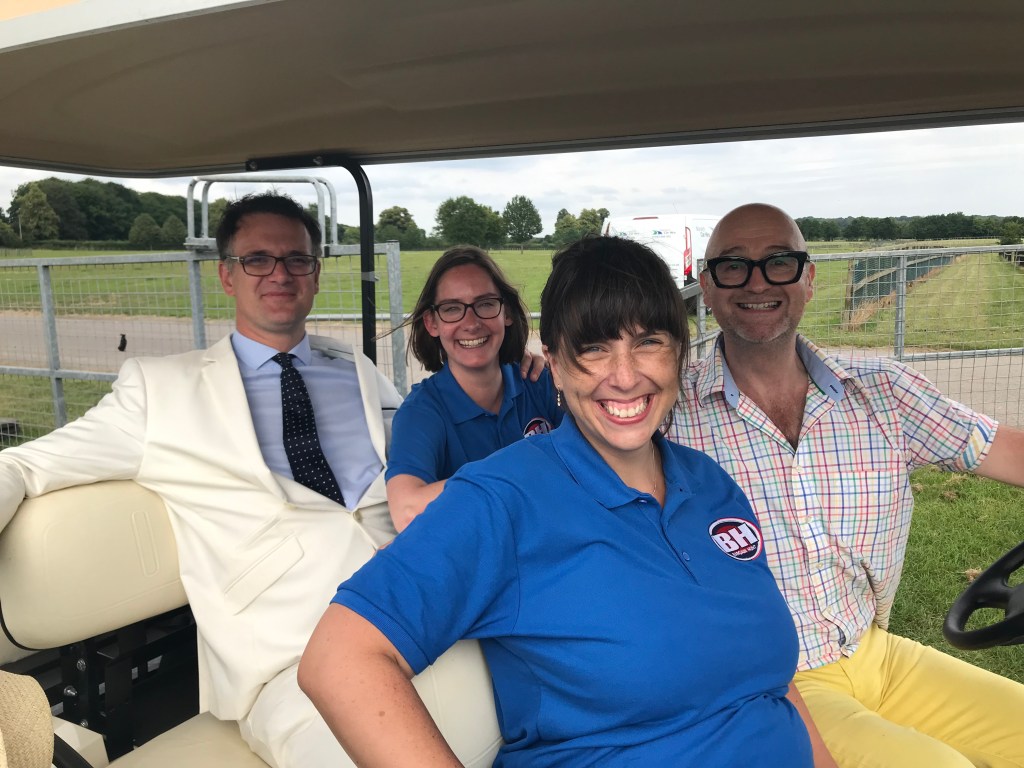
Bargain Hunt Newbury Fairground filming day – with David Harper and Charles Hanson

I want to introduce you to my friend Ally. She’s the one in beaming away in the back of the golf cart of the above pic.

Ally is glorious. She also spends her time healing the sick and telling people they don’t need antibiotics as a GP. But in her spare time she has joined me in appearing on Bargain Hunt (which it turns out is more competitive to get into than medical school). Super time had all round. The bargain hunt team are genuinely lovely and all A-ok about us not knowing much about the antiques business. Not to give the game away but it turns out that knowledge however may have been a little helpful.

The huge upside of getting on the show is keeping the trademark Bargain Hunt fleeces. And quids in for us – we did our filming over the summer so we all got a polo shirt to keep because producers clearly thought sweaty contestant look wasn’t great for the viewers.

It’s a slightly surreal experience being on TV (when you’re used to dishing out tonsillitis advice I mean). When you’re watching TV you don’t really every think about the filming that’s going on – apart from the endings of the Blue Planet, which show you in some detail how it took 50 people 10 years to get the few second dolphin sequence that you missed because you were replying to a text at the time. The filming crew are HUGE. So many vans. So many people following you around whilst you flounder over some disasterous antique purchase. And interesting bit of knowledge from the sound crew – they have to stop filming whenever any light aircraft goes by because it screws up all the sound really badly. I don’t think I’d have the patience for that job.

I had just had my second born when we were on our first day of filming. If anyone wants to know what it’s like to express milk in the middle of a field at an antiques fair whilst you wistfully gaze at cows roaming in nearby pastures, it’s weird. But also strangely liberating.

Anyway, the point of this blog apart from introducing Ally and sharing a milking-with-cows experience, was to say that new experiences are good! Go do something you’ve never done before this week! Even if you hate it, at least you’ll know you hate it for sure. And you’ll have something else to blog about.

If you want to check out the episode that Ally and I snuck in to it’s here – only available until the 4/11/19 so get cracking! Or don’t if you’re really not interested, we totally understand.

Ally and I are starting up a youtube channel focussing on health chats accessible to all. Kind of a (hopefully) friendly GP shindig with some useful thoughts and information. You can check it out here. Hope you enjoy! Or laugh. At least laugh.

Formula and breastfeeding – the minefield

6-8 weeks after a baby is born, mum and baby will have a check with their GP. I’m a GP and I’ve done many of these now. One of the questions we ask is how the baby is fed. I must admit I now have that sinking feeling asking the question, because alot of mothers who use formula milk will look at me with a sense of shame as they admit their feeding method. Now I am a mother and I sit of the other side of the desk, and I’m ashamed to admit I feel a sense of guilt having given my eldest some formula milk.

How have we got to a state where a mother feels they need to hide the way they give milk to their child? So we give formula – and we are judged for ‘failing’ our child. We breastfeed our child – and we get judged for getting a boob out in public. We express breastmilk and give in a bottle – and I’ve known people to be judged for giving a bottle to a baby and not offering the cuddles that a breast brings. We can’t win.

Education and informed choice

Some women don’t want to breastfeed. That is obviously completely ok – although I would argue it’s ok if that woman has had a chance to weigh up all the information on feeding for herself. This brings me to my first main point – lack of education. Education to women, mothers, men, children, society. Did anyone ever have a lesson on feeding a baby at school? When do we ever learn about it? Most of us will just hear about our mum’s journey, hear about some horror stories and have an NCT session on feeding. There is a raft of literature on both breast and formula feeding. Yes, you can read a summary from some – hopefully legit – website, but it’s a really complex issue that I honestly think needs much more face to face education. For everyone.

Breastfeeding support

Then there are many women who want to breastfeed but for a large number of reasons can’t. I personally very much feel for these women now I have personal experience of how shockingly hard breastfeeding can be. I have survived stretches of 7 night 12 hour shifts working in some of the busiest A&Es, but trying to breastfeed stands out as the hardest thing I’ve ever done. It completely broke me. My baby, Nina, would nibble off so much skin and tissue she significantly changed the shape of my nipple in the early days – yes, so much of the ouch. I recall one evening curled up in the corner of the lounge, crying with a whole array of emotions from guilt through to failure as I desperately tried to google someone who could help me breastfeed my child. And I’m a GP! I should know where to get the help! But I didn’t. How embarrassing, yes, but if I didn’t know, what about those who don’t happen to work in healthcare? I had the confidence to drive back to hospital, to an environment I know well, and ask for the specialist breastcare help from the ward, but would all women? In the end I managed to breastfeed my firstborn with expressed breastmilk for the large majority of her first 6 weeks, until, with the exceptional help of a health visitor, I was able to overcome the enormous number of issues to be able to directly breastfeed.

This brings me to my second main point – support. Women need support from day 1 of having their baby. All healthcare professionals try their best. My midwives have by and large been super, but they weren’t breastfeeding specialists. If someone had come to see me as a GP prior to my personal experience, my knowledge and advice I would have given on the topic would have been pretty limited. We need to be better as healthcare professionals at getting mothers the help from the word GO with breastfeeding. Day 7 is too late to offer help. I cannot stress this enough. Figures show most people have – quite understandably – thrown in the towel by then. We need professional help offered on Day 1.

Need for the right kind of feeding chats

There has now been some move towards not being up-in-your-face about breastfeeding. Healthcare professionals are not now allowed to be seen to over-pressure mothers to breastfeed. I totally get it. Infact, I definitely get this having now been personally exposed to the breastfeeding world. For some reason you can get the mothers that I term the breastfeeding police – those mothers who will judge you as their hobby for your despicable choice of giving your child something other than a boob. Interestingly I’ve seen the same mothers been totally fine having their kid exposed to or engage in other arguably unhealthy activity. Which links in with these annoying pesks not actually being interested in the health benefits breastfeeding may confer – they are interested in rubbing it in your face. I mean, how old are we?!

But women still need the information. We should be given this and processing it much, much earlier (like years earlier in my opinion) than when you’re holding your newborn. And then on the flipside healthcare professionals don’t like harping on about the amazingness of formula. So what you end up getting is something similar to what I got an a session put on for expectant mums nearby – none of the healthcare professionals talked about any feeding. One of them did try in fairness, but they were quickly shut down by a colleague. How ridiculous.

Feeding – a balanced view?

I was originally spurred on to write this blog by an article I saw in in the BMJ (British Medical Journal, kind of a big thing in the doctor world). Earlier this year the BMJ pulled all advertising of formula milk citing the negative impact it’s had on the breastfeeding world. They took alot of backlash for doing this as you can probably imagine. This month BMJ published an article on the impact of formula on the environment. I get it, we are (quite rightly) now in the day and age that any and all manufacturers of anything that has an unacceptable carbon footprint need calling out. But publish an article without giving a balanced view? Breastfeeding has an environmental impact! If you express breastmilk, you will usually do so now with a machine, and have to express into a bottle and store in a freezer with plastic bags. Even if you admirably exclusively breastfeed with no expressing, you eat TONS more food – that has an environmental impact. The article in my opinion was published by the BMJ in an attempt to justify their stance taken against formula milk. Even a renowned medical journal fails to give us all the information we need to be able to make our own minds up about milk for our babies.

How we choose to feed our baby has somehow become a hugely contentious minefield of an issue. And it absolutely should not and need not be. So much judging, so much negativity, so much misunderstanding, lack of kindness, lack of support. And a woman is exposed to all of this just as she’s pushed out a watermelon or had the pleasure of being sliced open on a chopping board.

Judging needs to stop.

Everyone needs better education. Women need better support – however they choose to feed their baby.

Featured

doctor lunners in a nutshell

I’m Hannah, hi! Thanks so much for reading this, or anything quite frankly because life is so busy it’s hard to find time to go for a wee before it’s getting pretty critical.

So yes, thanks. I’m a GP, mum, and lover of outdoors and sun and food. Man I love food. Very easy to say you’re going to watch the waistline but actually when 4pm comes round all you want is 1kg of cadbury, and nothing else will do. Nothing. And so the daily cycle of food shame starts.

I started writing this blog whilst on maternity leave with my second kiddy, James. He’s got classic second child syndrome and seems pretty happy with being left on a playmat for extended periods of time whilst I write about wee and cadburys and suchlike.

I probably started writing because I was talking at my husband, Chris, too much for his liking and so one evening he suggested I blog about all my excellent thoughts. And so my blog was born, and he now gets evenings of a free pass at playing that playstation game, you know the one where all they ever seem to do is ride a horse from A to B. Red Dead Redemption? What an appealing title. Anyway, win, win. Happy marriage.

So here in my blog you’ll be find my musings and amusements. I think it’s healthy for all of us to notice more in life, and think about stuff in whatever way we think is helpful for us. I’ll probably focus more on things I know about, like healthcare, being a doctor, a parent, a mother, the outdoors. But who knows to be honest, let’s not limit ourselves to a few categories. Aiming to get one more follower to add to my husband by october 2020. Dream big.

It would be nice if I could quote Oscar Wilde off the cuff, but english literature was never a strong point, so here’s one from Greenday –

So why are you alone wasting your time? You could be with me wasting your time! May I waste your time too? – Sassafras Roots, Greenday, reliably informed c.1994. Now I feel old. Oh, and look it’s nearly 4pm, cue the cadburys.